
For many years I pondered the Continent of Africa and the people who resided there.
Most of the images I’d seen through mainstream media were negative. The story lines covered by traditional media outlets spoke of either poverty, political, economic or social oppression and unrest. These descriptions contrasted greatly from the information that I had received from friends who made the journey to Africa – at least, as it pertained to the nature and character of the people. I had also read many books on the subject that gave a different perspective.
Not knowing what to expect, in March of 1999, I made my first trip To Ghana.


I was attending a small social gathering at a friend’s home one evening in February of 1999. I was well acquainted with some of the people there, particularly a small organization dedicated to the practice of traditional African culture and religion/spirituality.
The gathering was very lively, yet warm and easy.
The guest roamed the room freely, moving from one huddle to the next, engaging one another. The ambient sound of light-hearted laughter and conversation could be heard just below the African-Caribbean music being played.
The spicy aroma of West African cuisine permeated the atmosphere. Many were culturally dressed in bright colorful garments with exquisite detail and everyone seemed at ease and connected. Suddenly, there was the sound of drums, “boom bop bop boom…,” we all began to migrate towards this sound coming from another room. As I reached the thumbing rhythmic beat, I saw three meticulously hand carved wooden drums engraved with African adinkra symbols being played in unison. These were no ordinary drums, each one had a very distinct sound and look. The fontomfrom, dundun, and the djembe, each drum called out to the guest in melodious accord. Everyone began to gather around; the drummers appeared almost oblivious to the small crowd – tuned in to a rhythm and sound of their own making. A circle was formed and a beautiful barefooted woman dressed in shimmering waist beads, head wrap and flowing colorful garb, began her enchanted dance in sync with the cadence of the drums.


Her rhythmic dance was accompanied by the most lyrical piano-like sound. I panned the room to locate its origin and saw a short well defined man holding a small square shaped piece of wood with both hands. The instrument had staggered metal prongs layered across the top. As he plucked it with his thumbs, a wonderful high quality sound reverberated throughout the room, resonating with perfect pitch (this instrument is known as the mbira, or thumb piano). As the dancer performed, she smiled, gracefully bowing and gesturing with her hand, as an invitation to others into her sacred circle of dance. The energy of the evening was jubilant, yet sublime and serene.
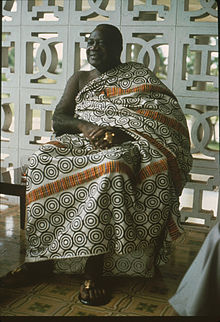
The purpose of this small gathering was to discuss the recent passing of Otumfo Poku Ware II, the Asantehene (King) of the Asante/Akan people of West Africa. Otumfo Opoku Ware II
As the evening progressed people were mingling about the home enjoying the food, music and conversation. I was off to the side conversing with one of the leaders of the organization, when another member, a tall attractive brown skin young woman joined us. With a subtle smile on her face, she placed her hand on the man’s shoulder that I had been speaking with and said, “Did you tell him?” The young man, also tall, was a charming fella; paused briefly, smiled back and said, “I was just getting to that.” Although I didn’t know exactly what they were referring to, the smile on their faces gave me a bit of comfort. He looked at me and said, “You know, we’ve decided to take a small delegation to Ghana on behalf of the organization, to pay respect to the Asantehene.” I listened, and he went on to say, “We would like for you to be a part of that delegation.” This came as a complete surprise. We spent the next forty-five minutes or so discussing some of the particulars of the trip. I felt an immense gratitude and excitement, mixed with slight caution.
Over the years my mind had been plagued by negative media images of Africa. Like the animated shoulder-demon depicted in old cartoons, the stories of Africa’s disease, crime and poverty had been reported with such consistent fervor that I had to pause. The image of Africa had been vilified. On my other shoulder stood years of research and personal stories from friends I knew and trusted – and of course, the overwhelming desire to experience Africa for myself. The fact that I would be traveling with folks that had made numerous trips to the continent was comforting and the opportunity to experience a royal funeral was both humbling and exhilarating. In addition, a few of the members in the delegation were recognized chiefs in Ghana. The things (private ceremonies) that I would be privy to on this journey was not available to everyone. After considering and consulting with my family, it didn’t take long for me to decide – maybe a day or two. Out of all the thoughts and emotions swirling around in my head, the most prominent was gratitude. I had not been a part of the organization for very long. I felt honored to have been selected. The members that made up the organization were some of the most genuine people I knew. It was indeed an honored.
Over the next few weeks I brushed up on my twi (twi is a dialect spoken by the Akan/Asante people of Ghana). I was asked if I would mind functioning as an okyeame (An okyeame is a master of oral expression, one who relays the words of the chief in a more artistic and diplomatic way without losing the essence of what is said). Okyeame

This made me more than little nervous. As long as they were speaking English I was fine. My twi was non-existent and I had literally no hope of improving it in such a short time. I studied feverishly up until a day or so prior to departure. Finally, just accepted what I had—nothing. As it turned out my services as an okyeame was not necessary, at least not as a speaker of the language. This gracious brother and his wife were really looking to introduce me to the culture in a hands on fashion (for which I am forever indebted). With that, I was able to relax and focus my attention on the experience and the majestic scenery of Africa. The ceremonies and celebration, the people, and culture, were all that I imagined it to be.
by K. Osei
 nature7blog